Think & Discuss
Quick Check
Inquiry Task
It is necessary to distinguish the measurement dimensions: economic indicators belong to the collective and capacity level, while subjective well-being belongs to individual experience. One should also check whether the survey questions presuppose the framework that “happiness is a subjective feeling,” whether the samples are comparable across different years, and what other factors may affect happiness. One cannot assert from a single survey that the two are eternally unrelated; instead, one should examine whether a possible transmission mechanism exists.
This page only points out that the two cannot be automatically equated; it does not claim that growth has no value. From “no automatic transmission” one cannot infer “should stop”—that would directly convert a descriptive question into a normative one. A more reasonable approach is to ask how growth acts on everyday experience and to evaluate separately the different meanings of the accumulation of power and individual happiness.
In recent centuries, humanity has achieved unprecedented growth in capacity, wealth, and energy. This growth is usually taken as a sign of historical advance: more population, stronger organizations, higher productivity, and a wider scope of expansion. But note that these indicators are measured at the collective and species level—they answer the question “how strong is humanity as a whole.”
Equating this kind of growth directly with “humanity becoming better” or “humanity becoming happier” is a common omitted step in the progress narrative. It treats the accumulation of power as a proxy indicator for the growth of happiness, but provides no independent justification for that step.
Success in the evolutionary sense refers to scale, power, survival, and expansion; happiness in the individual sense refers to a person’s feelings about their own life. The two belong to different measurement dimensions and cannot substitute for each other.
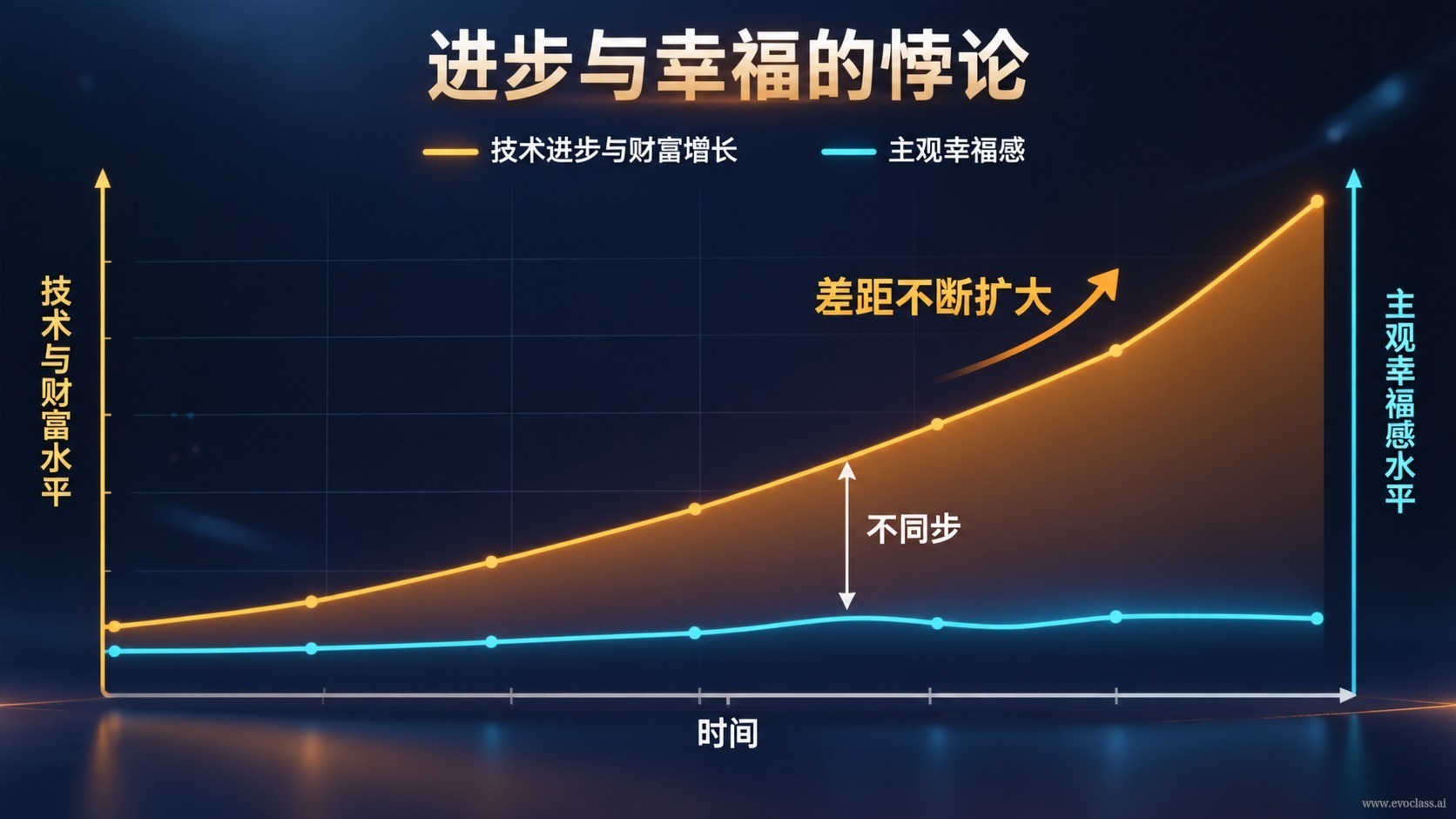
Therefore, “humans are stronger” does not imply “humans are happier.” A rise in indicators does not equal an improvement in experience, and there is no automatic transmission mechanism between them. This is precisely the rift between progress and happiness.
If the evaluative scale is switched from “the overall capacity of humanity” to “individual lived experience,” many dimensions covered up by the capacity–wealth curve come to the surface. Take the tens of thousands of years of forager life between the Cognitive Revolution and the Agricultural Revolution: they too had celebrations, moral codes, athletic competitions, and religious rituals, as well as war. These experiences cannot be simply summarized by a “capacity–wealth” curve.
This also points to a deeper premise question: defining happiness assubjective feelingis itself a view shaped by particular historical conditions. Different religious and intellectual traditions often assert that objective standards for the good and the beautiful exist, and remind us to “know yourself”—implying that ordinary people may not truly know their real selves. Whichever position one takes, progress indicators and the experience of happiness are not the same ruler; the direction of inquiry should shift from “how strong is humanity as a whole” to “how do these increases act on individuals’ everyday experience.”
A dual-axis line chart, with one line showing the growth of technology and wealth and the other showing changes in subjective well-beingLook at the dual-axis line chart, where one line shows the growth of technology and wealth and the other shows changes in subjective well-being. Think about how it relates to the idea that “historical progress and subjective happiness cannot simply be equated.”